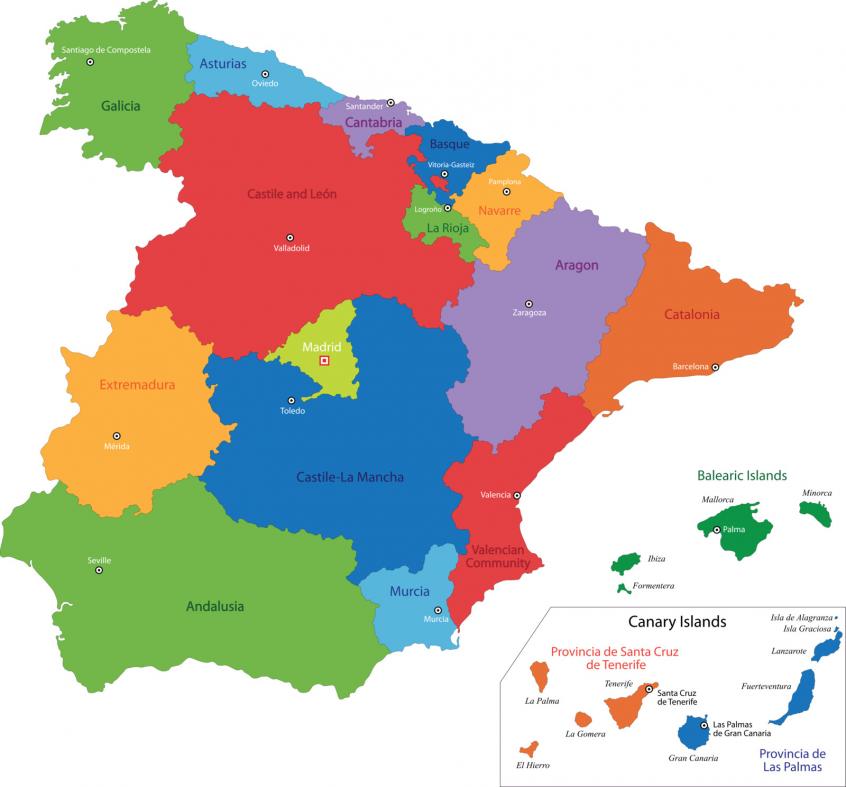
Lingo-Late.com recently published 12 Gamesforlanguage travel blog posts. They include experiences and advice staying in the cities of Barcelona and Seville for a month, as well as learning and practicing Spanish. Spain is a wonderful country to visit and to live in.
During their stay in Barcelona, the authors realized that knowing Spanish in Barcelona is not enough, as they studied and solved the mysteries of Catalan menus in their favorite restaurants; they experienced first hand how the conflict between Catalonia and the Spanish government in Madrid plays out in friends' comments, such as : “When I go to Spain...” or “The taxes we are paying to Spain...”. Many Catalan people don't see themselves as a part of Spain. In Seville they experienced the “Semana Santa” with often scary-looking procession participants; they were often challenged by the local dialect, a typical experience of many who learn the “standard” language. The experience with a local ATM and bank in Seville made it clear to them that English is not spoken everywhere.
Several posts also describe the benefits of traveling off-the-beaten track. In addition to visiting “must-sees” like Cadiz, Granada, Ronda, Cordoba, Toledo, visits to Carmona and Almagro offered particular experiences and insights.
For those who plan traveling to Spain or staying in a city for longer these posts can serve as a resource and guide.
In 2018 we stayed in Budapest for a few days. Different from previous travels, we did not learn any Hungarian words and phrases beforehand. We therefore felt quite handicapped not even knowing the basic greetings and "essentials", such as yes, no, thank you, please, etc. In Duolingo and many other apps and online programs, it often takes a while before you can get to or even find such language "essentials". So the idea of Lingo-Late was born as a site for people like us: language lovers and travelers later in life, who want to learn and practice at least the language "essentials" before any foreign trip. We started Lingo-Late.com in early 2019 and plan to add - over the coming weeks and months - 50 to 100 essential words and phrases for most of the European languages. Initially, each lesson will have 10-15 words and phrases, with translation, audio, and a voice-recording feature. Later on, we may add some simple dialogues and games. We've started with French, German, Italian, Icelandic, Spanish, and Portuguese, and will then add Dutch, Swedish, Danish, etc. Lingo-Late does not replace Gamesforlanguage, which we'll continue to improve and add on to.
These short games - which can be played without registering or logging in - are a fun way to learn and practice small chunks of Spanish.
Brief explanations accompany the games. Currently German and Spanish games are posted daily on our "A Game A Day" Facebook pages, followed by links to related topics or sites later in the day.
¡Que te diviertas !
Learning and practicing a new language - playfully...
Did you have to learn a foreign language in school? Do those language classes not trigger happy memories?
Even if they do, chances are your current job and/or other commitments don’t leave you enough time to continue taking formal language classes.
But you don’t have to give up on your dream of becoming fluent in a second language:
Make learning a new language your hobby.
There are numerous advantages to learning a language this way:
Your goals are your own, and they can change as you progress.
You learn to set your own pace and milestones. Preparing (or cramming) for exams is no longer an issue. You can push yourself to accelerate your learning, but you won’t get a failing grade if you don’t reach your ambitious goal.
You can start speaking the language when you’re ready. You won’t get called on by a teacher and have to stammer your way through some kind of foreign-language answer.
Homework gets a new meaning. You can combine vocabulary and pronunciation practice with listening to songs, watching a film, or reading a book in your new language. There are many fun resources that help to keep you motivated.
Mistakes? Who cares! No one starts speaking a language correctly from day one on. You may even learn to welcome friendly feedback. In any case, when you get corrections, they won’t affect a grade or your self-esteem. Read on to learn how to make language learning your hobby...
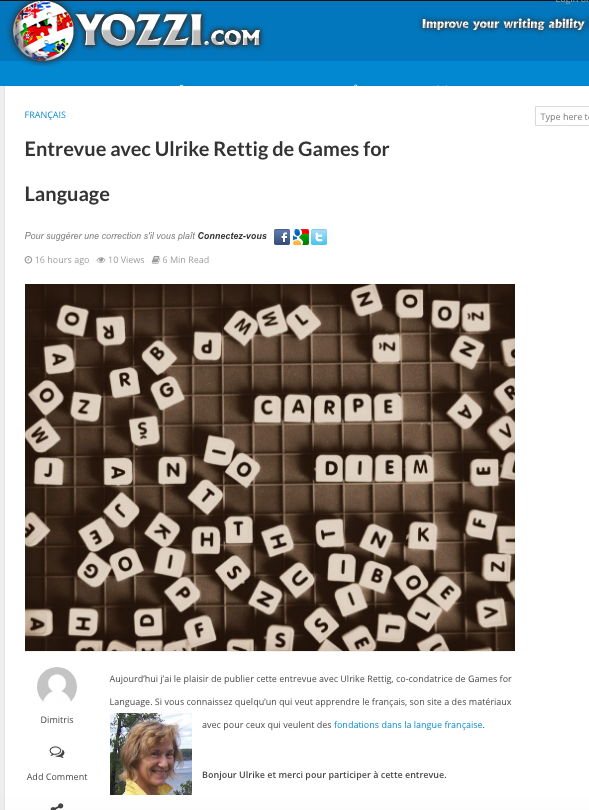
Ulrike Rettig, Co-Founder at GamesforLanguage.com, is featured in an interview in French at Yozzi. Dimitris Polychronopoulos, the founder of Yozzi.com conducted the interview. Neither Dimitris nor Ulrike are native French speakers, so they took this opportunity to practice their French. The idea behind Yozzi is for people to practice their target languages at an advanced level, beyond what you find at Lang-8.
Yozzi also has a comment system which makes it easy to point out ways to help advanced language learners improve in their target languages.
Here is the beginning of the interview in French:
Aujourd’hui j’ai le plaisir de publier cette entrevue avec Ulrike Rettig, co-fondatrice de GamesforLanguage. Si vous connaissez quelqu’un qui veut apprendre le français, son site a des matériaux avec pour ceux qui veulent des fondations dans la langue française.
Bonjour Ulrike et merci pour participer à cette entrevue.
Vous parlez plusieurs langues: l’allemand, l’anglais, le français, le néerlandais, l’italien, et l’espagnol. Est-ce que vous pouvez raconter votre histoire pour nous dire comment vous avez appris les langues que vous parlez?
In July/August last year we were interviewed by Erik Zidowecki of Parrot Time. We answer questions about how Gamesforlanguage.com got started, what we tried to achieve and what our future plans are.
Here is an excerpt:
How did your website, GamesforLanguage, get started? Is there a particular message or goal with it?
The idea of GamesforLanguage came out of our own experience with Italian, a few years ago. We were planning to spend six months in Rome. To prepare for our stay, we learned Italian from scratch with Pimsleur's audio courses (3 Levels, 90 lessons), by squeezing 30 minutes of audio learning into each day. When we arrived in Rome, we found we could use basic everyday language and had a pretty good pronunciation.
However, we had great difficulty with reading and writing Italian. That was a real handicap. We could not even write simple sentences as our French interfered with the Italian spelling. It seemed to us that all four language skills should be practiced.
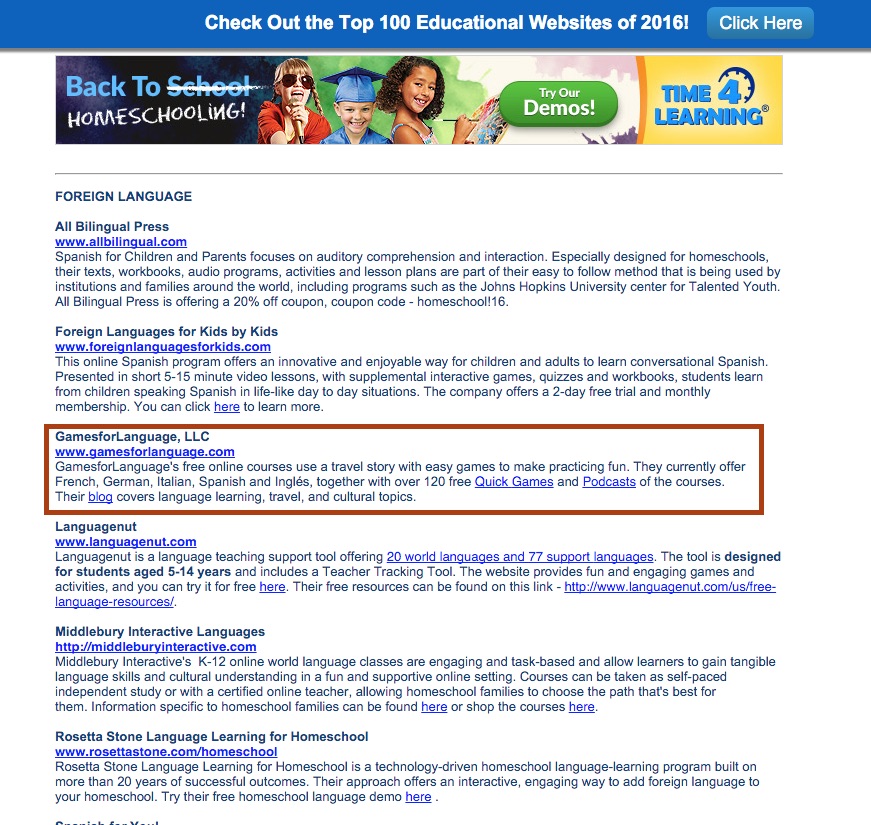
We are excited that GamesForLanguage was nominated by multiple homeschool families as a top educational website for 2017 on Homeschoolbase.
GamesforLanguage is listed in two Award Categories:
Top 10 Award in the History, Music, Art, Foreign Language Category and
Top 100 Honor as one of the 100 Best Educational Websites 2017
Gamesforlanguage's FREE online, story-based Courses and Quick Games for French, German, Italian, Spanish, and Inglés make learning and practicing fun.
After hearing a dialog of “The Story” at the beginning of each Scene, players then learn the words, phrases, and sentences in easy games.
Players practice their listening skills with the Podcasts before or after they have completed a lesson; they focus on speaking and pronunciation by repeating after the native speakers in the “Say It” and “Record It” segments.
Learners can practice with Quick Gamesand Podcasts without even registering or logging in.
Weekly Blog posts cover language learning, travel, and cultural topics to keep users engaged and motivated.
All GamesforLanguage courses and Quick Games are online and free, and accessible on most handheld devices.
HomeschoolBase.com is a modern resource for homeschooling. It is the fastest growing online resource, news source, and community blog for home schools.
Ulrike was recently interviewed by Brent Sverdloff for Flexyourmemory
Here is an excerpt:
Brent: Ulrike, it’s terrific to reconnect with you! When we worked together more than 20 years ago, it was always fun to indulge our passion for languages. Now we’re doing it in the context of memory.
Ulrike: It was great to hear from you! The role of memory in language learning is a complicated and fascinating one. I'm fluent in four languages and on an intermediate level in two more. For the thousands of words I know in each language, I think I've consciously memorized only a fraction.
Brent: For centuries, the preferred method of language teaching was rote memorization. Do you still think that’s relevant?
Ulrike: Obviously, we acquire much vocabulary and grammar in other ways than by rote learning. Still, deliberate memorization through repetition and practice is important for learning a language, especially if you're an adult.
Brent: Learning a foreign language means reading, writing, listening, and speaking. Do you think they can be prioritized in order of effectiveness?
Contrary to some popular marketing slogans (“Learn a foreign language like a child”), adults cannot really do that.
Because they have already learned their native language and are able to read and write it, adults cannot acquire a foreign language like a child.
As adults, we have to take a different – our own – path for learning a new language.
For a starter, we should pay attention to our likes and dislikes.
In addition, being aware of HOW we learn, can make learning interesting and ultimately quite effective.
LEFT AND RIGHT BRAIN
Research on left brain (logical, verbal, auditory, sequential) and right brain functions (creative, visual, spatial, emotional) has been ongoing for decades, and new imaging techniques have greatly enhanced our knowledge of how the brain works.
It’s no mystery that learning a language involves many functions of the brain for everyone.
For example, we now also know, that new words are “encoded” in our brain and once they are “consolidated,” they start shifting from short-term to long-term memory.
You can read more about LingoHut where you’ll find free language lessons, activities and articles on how to make language learning easier, or visit LingoHut’s Facebook page.
Gamesforlanguage's FREE online, story-based Courses and Quick Games for French, German, Italian, Spanish, and Inglés make learning and practicing fun.
After hearing a dialog of “The Story” at the beginning of each Scene, players then learn the words, phrases, and sentences in easy games.
Players practice their listening skills with the Podcasts before or after they have completed a lesson; they focus on speaking and pronunciation by repeating after the native speakers in the “Say It” and “Record It” segments.
Learners can practice with Quick Gamesand Podcasts without even registering or logging in.
Weekly Blog posts cover language learning, travel, and cultural topics to keep users engaged and motivated.

 Lingo-Late.com recently published 12 Gamesforlanguage travel blog posts.
  In 2018 we stayed in Budapest for a few days. Different from previous travels, we did not learn any Hungarian words and phrases beforehand. We therefore felt quite handicapped not even knowing the basic greetings and "essentials", such as yes, no, thank you, please, etc.


 We are excited that GamesForLanguage was nominated by multiple homeschool families as a top educational website for 2017 on