
What can you learn with Language Games?
 A recent blog post of ours reviewed some answers to the question: Can Playing Language Games Make You Smarter?
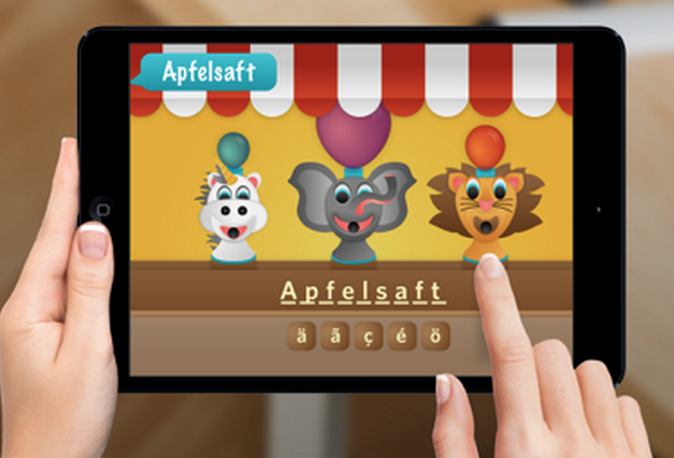
Anyone scanning the Internet will find a huge number of online language games and learning programs. In addition, there are lots of apps available for phones and tablets, including iPhones and iPads.
Those are all a tremendous resource for language lovers! And a lot has happened since we asked the question: Why Games?
Flashcards Do Work!
Many of the online programs and apps are based on a flashcard model, and teach words and short phrases only. Flashcards exercises are indeed an excellent way to drill and recall vocabulary. They are also perfect for grammar items, such as verb conjugations, adjective endings, noun genders, contractions, etc.
In digital form, flashcards can space recall optimally, and often use pictures and combine visual and auditory information. You’re in charge of your learning and you can easily track your progress.
Are Flashcards enough?
However, one may reasonably ask: Can you really learn to SPEAK a language by just memorizing words and word forms? For most of the European languages – and those are the ones we know best – we believe, the answer has to be no!
The reason seems quite obvious: Conversations and narratives are not just a series of isolated words or phrases. In order to create meaning, you have to choose the right words and put them into a particular sequence. Often, it's the sequence that is crucial for the meaning. As a starter, you need to show whether you're making a statement or asking a question.
Add to this the need to find the correct gender of the noun (and, depending on the language, also the correct ending), the right tense and verb conjugation, the position of a preposition, etc. - and it becomes clear why speaking a foreign language is not an easy process.
The Language Games Challenge!
The challenge to those of us who are developing online language games or apps is this: How to create compelling games that can teach much more than a series of words and phrases - games that build the confidence to communicate?
It's the repeated use and practice of phrases and sentences in a meaningful context, that will ultimately enable you to speak with some fluency. Words and grammar rules are not enough. Conversations are a process of dynamic communication. By the time you have deliberately constructed the perfect sentence, the conversation may have already moved on.
In future blog posts, we’ll review some of the available language games, and please, share with us your experiences!