It's been about a year now that daily life has been upended by the pandemic. Like most people, we at GamesforLanguage have gone through various kinds of moods and emotions. As you can expect, the pandemic blues have included periods of heightened boredom and lowered motivation for language learning. We are looking forward to more moments like these four boys are enjoying. (Photo by Robert Collins on Unsplash)
It's been particularly hard to be separated from family and friends. At times Zoom fatigue has set in, and texting doesn't do the trick all the time either.
We also sorely miss traveling. We have siblings, cousins, nieces, nephews, as well as long-term friends all who live in Canada and Europe.
Besides, over the years travel had become an important impetus for our language learning. We've enjoyed travel and one-month or longer stays in several different countries, as you can read in our European Travel series on our Blog.
This past year has been tough. But here we are, still using our languages and striving to improve our fluency. The months grounded at home have made us think a lot about what motivates us to keep on learning languages.
What Has Helped Us to Keep Going?
1. Having a routine
For better or for worse, we've hung on to some kind of a language learning routine, even though we've sometimes struggled to stay motivated. Our routine may have thinned out, but it's still the backbone or our language learning and has kept us going.
2. No rote learning
We've scrapped memorizing lists of random words or phrases. Learning a language in context is so much easier and more interesting. Indeed, we find it essential.
3. Short and focused language practice
We continue to use online language programs, but only for short periods. At the moment, I'm playing Spanish GamesforLanguage course lessons every day, and am just about to finish Level 3 of Duolingo's Dutch. Ulrike has started Finnish on Duolingo and also does daily Swedish lessons. (Once travel is back, we're planning to visit those two countries.)
4. Grammar in baby steps only
For now, grammar is to be enjoyed only in sweet little bites. Only when a phrase or sentence just doesn't make sense, do we resort to some grammar sleuthing. We treat grammar like fun little puzzles to be solved.
5. Lots of passive learning
A large part of engaging in our languages has been watching news programs, listening to interesting podcasts, and watching foreign TV series and films (with or without subtitles). We watched the entire Italian Inspector Montalbano series, as well as various French, Spanish and German series on Amazon Prime's MHz channel.
6. Reading and listening to interesting stories
To practice my Dutch, I recently purchased Olly Richard's Dutch Stories for Beginners. They are a little wacky, but made great bedtime reading. (Maybe I even improved my Dutch while sleeping.)
Both Ulrike and I regularly read or listen to French stories and novels. The latest: Michel Bussi: "T'en souviens-tu, mon Anaïs"; Guillaume Musso: "Un appartement à Paris", "La fille de Brooklyn"; Dominique Manotti: "Racket", "Marseille 1973".
7. Exercise, sports, walking
This has been really important for us. Lots of walks, tennis outside in the summer, at least 20 minutes of exercise every morning. We both work at a "walking desk". Exercise may not seem immediately relevant to language learning. But it's been well documented that it can sharpen memory and thinking skills.
All these above activities have helped us stay with our various languages. It's been clearly a question of how to make language learning fun and to avoid getting bored. Is there a "secret ingredient"?
Young Children
When we watch young children, we marvel at the ease they seem to learn their native language. Children acquiring their first language will focus on learning how to use it. It's like a full time job for them. It takes their full attention. Boredom is not an issue.
It's the same for young children who live in an environment that totally immerses them in another language. And even older children seem to be able to pick up a new language quite easily when there's lots of interaction with friends and family who speak the language. It's the social component that's crucial, while more structured learning (drills, exercises, practice) helps to build vocabulary, and improve pronunciation and grammar skills. (See also how our 10-year old grandson learns French with GamesforLanguage.)
Several of our grandchildren are taking regular French lessons online, which has them talk with a tutor and requires them to listen and speak. They seem to enjoy this a lot, especially because of the live interaction.
Challenges for Adult Learners
What makes learning a new foreign language as an adult so challenging are many factors, among them: • Our increasing difficulty with time (starting in late childhood) to accurately hear sounds that are different from our native language, as well as producing those new sounds when speaking.
• A busy life that leaves little time and energy for extensive daily focused language learning.
• Language programs that are not engaging enough to sustain our frequent and regular use.
What Makes Online Language Learning Courses and Apps Engaging?
There are several elements that can make language learning more engaging.
1. Social contact when learning a language
Children learn languages through their social contacts with parents, caretakers, siblings, playmates, etc. Adults can replicate such contacts to some degree in live or online language language classes. But clearly such interactions cannot compare with the time that children spend speaking and listening.
Many of the apps and programs also include user forums where learners can ask questions, and interact with others, etc. With italki and similar platforms you can book private tutors, which does provide social contact and more customized learning with emphasis on listening and speaking.
Immersive language programs, such as offered at Middlebury College, VT, rely heavily on the social contact aspect of only communicating in the target language.
We've just learned about a new option: Pangea Chat. This platform has just become available online, in the App Store and on Google Play. On Pangea Chat, friends text each other in their native language. These exchanges are then automatically translated into the chosen target language and put into gamified “activities” for practice.
Pangea Chat would seem to check off the "social contact" and "relevant, comprehensible input" boxes that we discuss below. We are planning to review the app once we have used it for a while.
2. Interesting topics and relevant input
This is what many language programs are lacking. Especially for beginners, language lessons are often limited to what the teachers or developers consider essential first words and phrases.
Steve Kaufman of LingQ is a great proponent of “meaningful input that matters to you”. He expands on what the well-known linguist Stephen Krashen thought of as the essential requirement for language learning: “comprehensible input”.
LingQ's approach certainly applies the idea of "comprehensible input". Subscribers to the program can read and listen to content that they are interested in. Translations are available as needed.
This is different from the Rosetta Stone method, which uses pictures that the user has to match to a foreign word. That quickly became boring for us.
Most apps and language programs rely on some form of translation to provide “comprehensible input” for the learner. However, the lesson topics include mostly the words and phrases of categories such as “Basics”, “Greetings”, “People”, “Travel”, “Family”, "Activity”, “Restaurant”, “City”, etc. (as in the early lessons of Duolingo's French course).
For learners who are really serious about learning a new language, Gabe Wiener's Fluent Forever app, starts with the sounds of the foreign language. The app uses images and flashcards to teach you vocabulary and lets you also customize your learning. This is followed by stories with which you learn grammar. Finally, you can practice with native tutors. A motivated learner who uses Fluent Forever regularly, will certainly progress quickly.
3. Games for language learning
When Duolingo appeared 2011, just about the time when we launched Gamesforlanguage.com, gamified learning suddenly became the craze of the day. Many of the programs and apps we have tried also include some form of games.
Games are clearly a compelling technique for learning: They provide a challenge, they let you know when you're right or make a mistake. As language learning also relies on memorization and repetition, you can repeat the games until you “get it”.
However, after a while even games can become a little tedious, if they don't involve “meaningful input that matters to you”. That was the reason why the GamesforLanguage courses use a travel story rather than unrelated words and phrases. (Admittedly, even travel stories of a young traveler can become boring when you repeat them several times.)
4. Success feedback and voice recognition
Most language learning apps and programs today use some form of feedback.
Over time, Duolingo has evolved a number of such feedback parameters, including a daily goal and point counter. These show up in a chart, achievement levels, a streak counter, etc. LingQ tracks the number of known words and now also has a streak counter, and so do Mosalingua and Fluent Forever. Including a “streak”, that shows how many days a learner has been learning in a row, seems to become ever more popular.
When we tried Babbel the last time, we did not like the voice recognition feature. Duolingo on it's AppStore app also uses voice recognition, but the feature is easily fooled. We suspect that it will only be a matter of time until voice recognition will be smart enough to be incorporated into many language programs to provide real-time feed-back to the user's pronunciation.
Until then, speaking aloud and recording yourself is still the best way to practice new sounds and comparing yourself to native speakers. (Unfortunately, and different from a live dialogue with a friend, this is both time consuming and quickly becomes boring as well.)
So, we have found that the best language language learning "package" for self learners would consist of a combination of meaningful social interactions and resources that provide interesting and relevant input. If you like music and singing, learning the lyrics of a song in your target language could work well. (Here are our suggestions for French, German, Italian and Spanish songs.) To add some fun to pronunciation practice, and vocabulary and grammar building, I would add some features that include gamification and feedback.
Let us know which language learning programs and apps are engaging for you, and in particular, which elements keep you practicing regularly.
Ten years ago, GamesforLanguage started out as an experiment and family project: a language teacher and course editor, a retired engineer, a computer programmer (our son) and his graphic designer wife collaborated on what has turned out to be a fun and rewarding enterprise.
Over the years, we've had a steady stream of users and have gotten valuable feedback. We've also found plenty of incentive for our own language learning by using our own courses, joining online language learning groups and trying out other language programs and apps.
Our site is free to all - without any Google advertisements - a fact that more and more teachers and parents seem to appreciate as well. You can play our Quick Games and Podcasts, and read our Blog Posts by just clicking on the links.
Only our language Courses require a simple registration. This way, players can pick-up the story and continue learning and practicing where they last logged off.
At the beginning of a new year, we usually look back to determine what has interested our users most. Over the last few months of 2020, we've noticed a substantial increase in groups playing our Quick Games and travel-story Courses.
Registrations increased by users with an institutional email address, in particular schools. Most of the students registered that way play Courses in addition to Quick Games.
Although we don't know the email addresses of users who just play Quick Games, Podcasts, or read our Blog Posts, we are able to identify which content receives the most traffic.
Travel Story Courses
Our original purpose for Gamesforlanguage was to combine the idea of learning a new language with a travel story and fun games. Being language learners ourselves, we've used (and are still using) many different language programs.
Not surprisingly, it was our German courses that had the most players from registered users last year. This may also be due to the fact that we have two(2) 36-lesson German courses, as well as an active German Facebook page.
If German or any of our other languages - French, Italian, and Spanish - interest you, click on the registration page or the screenshot above, and register. (Our Course English for Spanish Speakers is still in development and has 3 levels at this time.)
Quick Games
We currently have over 300 Quick Language Games, and we are adding new games every few weeks. These can be played by just clicking on the Quick Games link on our website and selecting the language you want to practice.
Each fun game only takes a couple of minutes or so. It helps you practice a few words, a grammar point or some typical phrases.
We post one of the nearly 90 Quick German Games every weekday on our German Facebook page, Learn German -A Game A Day.
Since we started Gamesforlanguage in January 2011, we've added nearly 400 Blog Posts about language learning, travel experiences, and related topics. That's an average of over 3 posts per month.
It's always interesting to see which of the older posts have become perennials. Our 2013 post about La Paloma Lyrics - Learning Spanish with a Song, was also a favorite in 2020. (And if you like that idea for learning Spanish, we can suggest one of our partner sites, Language-Zen.)
For those who have tried our travel-story based Courses, it's no surprise that we like stories for learning and practice. We are obviously not the only ones. Our 2016 post: Why Polyglots Also Use Stories for Language Learning has been very popular.
And, as it's quite a short post, we're always surprised to see the 2013 entry - Quick French: “On y va”, “Allons-y!” - to be on our most read list year after year!
Podcasts
We have not yet promoted and expanded our Podcasts. (Something we're going to focus on in 2021.) Most of our podcasts are the MP3 audios and chapters of each of our courses.
We believe that listening to the story BEFORE or AFTER playing a course lesson, helps you to internalize the sound and rhythm of the language and to memorize the phrases.
We are planning to add more Podcasts about Language Learning, Culture and Travel.
We're hopeful that in the fall of 2021, we can again travel to Europe. In any case, until travel is safe again, there' s plenty of time to practice languages online, to read books, to listen to podcasts and to watch foreign movies.
In the fall, we'll be spending two weeks in Bordeaux, France. So, before we get there, I'm super eager to take my French up a notch or two.
If I'm an Advanced learner (C1-C2), as I am with French and Dutch, or an Intermediate (B1-B2), as I am with Italian and Spanish, there are many resources to choose from: online programs, books, audio books, Ted talks, TV series, news stories, etc.
If I'm a Beginner (A1-A2) in the language, as I am with Swedish or Portuguese, I look for apps or online programs with words and phrases. Later on I'll start reading simple texts and listen to (slow) audios.
Free options like Duolingo and Lingohut can give you a good start. Others, such as Babbel, Mosalingua, Pimsleur, LingQ, Busuu, etc. also ask you to spend some of your money. (And - if you want to learn/practice polite phrases and greetings just before your next trip to Europe - take a look at Lingo-late.com. More about that below!)
The most important thing to keep me going is to choose interesting materials. I try to do something every day.
Below are 9 Practice Techniques that work for me. They are in no particular order, and I don't do each one every day. I practice a language when I can and feel like it.
1. Listen and Repeat (without seeing the text)
• Focus on the sound of words without visual interference. • Imitate how words run together in phrases and sentences. • Practice sentence intonation. • Notice how the different intonation of sentences can change their meaning. • Learn to listen for patterns in the language.
Pimsleur Language Programs are a good method for this. We practiced with 90 lessons of Pimsleur Italian before spending 5 months in Rome. I ended up with a pretty good pronunciation and some basic phrases I could use. (But I still had to learn to read Italian and my vocabulary was very limited.)
Later, I used the 'listen and repeat' program, Ripeti con me for Italian. For Spanish, it was the fun app. SuperCoco.
2. Listen and Read
• Correlate the sound and spelling of words and phrases. • Become aware of typical letter combinations. • Notice "silent" letters that are written but not pronounced. • Look for grammar patterns in the language.
Knowing how written words sound is very helpful for asking directions, for ordering from a menu in a local restaurant, etc.
We had our Pimsleur Italian experience before DuoLingo came out in June 2012. The wish to correlate text and sound digitally for learning a language was the impetus behind GamesforLanguage, which we launched in September 2011. Our courses and games helped me catch up on my Italian reading skills, expanded my vocabulary and kept me in pronunciation practice. They also gave me a good start for Spanish.
DuoLingo Stories are a fun way to read and listen. They started to come out in 2017, and are now available in Spanish, Portuguese, French, and German. You go through the story sentence by sentence. When you click on a word, the English translation comes up.
Olly Richards of IwillteachYouALanguage has a series of Readers with audio in various languages and for different levels. I've been using Spanish and Italian Stories for Intermediate Learners, and now also Swedish for Beginners. Typically, I listen to a story once while following the text. I write down a few key words that I don't know and look them up if I need to. Then I "listen only" to the story several more times.
3. Interactive Play (flashcards and games)
• Mix it up and add some fun by learning interactively. • Use flashcards to learn vocabulary and test yourself. • Build basic language skills for listening, speaking, reading, writing. • Focus on practicing your pronunciation.
Create a "streak" or build "points" to motivate yourself.Many programs now offer interactive, gamified language learning: DuoLingo, Babbel, Memrise, Busuu, Drops, and yes, GamesforLanguage.
I've used all of these at one time or another, with GamesforLanguage, of course, being my staple. Interactive play doesn't replace having a conversation with a native speaker, but it's a fun way to get in some practice time. It's a great way to learn a language bit by bit.
4. Read Silently
• Practice reading fluently, without stopping if you don't know a word. • Guess the meaning of words from their context. • Notice verb tense markers, eg. whether the verb is in the present, past, future. • Be aware of "who is speaking", as some languages drop pronouns.
Once you are able to read on a high Intermediate level in the language you're learning, there's nothing to hold you back. Reading is a powerful way to acquire new vocabulary and absorb grammar structures intuitively. When you start reading things that really interest you (novels, non-fiction books, news articles), the language is yours.
5. Read Aloud
• Practice reading aloud fluently, focusing on phrase and sentence intonation. • Pretend you're a native speaker and add some drama to your reading. • Record yourself and playback. • Have a native speaker give you feedback (live, or of your recording).
A couple of years back, our French-speaking nephew visited us with his family while we were spending a month in Barcelona. His daughter was four at the time. She asked me to read her a bedtime story in French. It was cute, because like a teacher, she corrected my pronunciation here and there. (My French tends to have a German accent.)
The next day, I noticed that reading aloud had a clear benefit. It made me more confident in speaking French, which in turn improved my fluency.
6. Listen and Write (dictation)
• Learn to identify words by their sound only. • Produce the spelling of the words and phrases you hear. • Be aware of word endings, agreement, etc. which may be "silent".
I've always enjoyed practicing a language with dictation. It's very satisfying when you figure out what the sound you hear means and you get the word(s) right.
Producing the written version of words that you hear helps you to remember them better than just reading them.
To practice with dictation, I take an audio that I can easily stop and start again as often as I want. An audio book is perfect for that. I've also used TED and TEDx-talks that are not too long and deal with subjects that interest me.
7. Just Listen (and watch)
• Get the meaning of each word or phrase through the context. • Get used to the language spoken at normal speed. • Pick up everyday conversational phrases. • Learn the vocabulary around a particular topic.
Recently we've also listened to Yuval Harari's Sapiens in French. And while I may not have understood each and every French word, I certainly got the meaning of every sentence. And I'm sure, my vocabulary was further enriched.
8. Have a Conversation
• Anxious about having a conversation? Prepare yourself! • Write down phrases and sentences you think you'll to use, and practice them. • Look up vocabulary on topics you think may come up. • Prepare some questions to ask your conversation partner.
All the Listen-and-Repeat or Reading-Aloud practice will help to prepare you for real conversations. Your mouth mechanics will have gotten lots of good practice, so anxiety about pronunciation will be less of an issue.
And don't underestimate the value of talking to yourself in the language you're learning. Have a self-conversation about things you need to do, things you've done, things you notice around you, etc.
9. Write an Email, a Chat Message, keep a Journal
• Try to write fluently, to say what you want to say. • Then go back and see if you can catch any errors. • Leave a space for words you're not sure about, then look them up. • Note words you want to learn in your Vocab Booklet.
It's hard to write spontaneously in a foreign language. Your native language (or another language you're learning) often interferes. Still, if you focus on what you want to say, and not so much on grammar, your writing will make progress. Pretend you're just having a conversation with a (non-critical) friend, and write that way.
I'm not someone who spends hours and hours a day drilling and practicing languages. But I do speak a few languages. I've accumulated these patiently, step by step, always finding fun in learning, and always looking for opportunities to try things out.
I've also found that traveling is a great motivator for learning and practicing a language. Before every trip to a country where I don't speak the language, I spend some time learning useful polite phrases, greetings, numbers, etc.
Greeting people in their local language, thanking them, ordering in a café, asking for directions, these are all ways to show respect for the people whose country or region you are visiting. Just think how you'd feel if the tables were turned.
(In fact, the realization that we can't learn all languages for the European countries we like to travel to, made us start a new site, Lingo-Late.com. Here we've begun to add the 50-100 most useful - “essential”- words and phrases for most European languages. The site is free and you can Listen, Repeat, Record you voice, and Playback any of the phrases.)
How to deal with grammar is a question we get a lot from language learners. Yes, classroom learning often focuses a lot on grammar. I also plead guilty to having used this approach with students during my college teaching years.
But I now know that it does not help your speaking abilities early on. Fortunately, if you're learning a new language independently, it's okay to put grammar on the back burner.
Still, not focusing on grammar doesn't mean you ignore it completely. A good approach is to start with "baby steps" to learn gradually how your new language works.
Grammar in any language is a huge subject. However, knowing a grammar book inside out doesn't mean you can communicate in the language. All it means is that you can remember a lot of abstract rules. And these don't automatically translate into fluent communication.
So, what are a few "baby steps" that self-learners can take? Here are the steps that work for me when I start out in a new language. (My examples are from the four languages on our site.)
Step #1: A Quick Glance At Grammar Basics
I do mean a "quick glance", and really just basic grammar. Do it in whatever way works for you - on the internet or in a basic grammar book.
You don't really want to know ALL the grammar rules right off. Especially not all the dozens of exceptions to those rules to boot.
What you want to know is how your new language works. How it is essentially different from your native language(s). Knowing these main differences will help you when starting out with conversations.
PRONOUNS In English, you always use pronouns. The same goes for German and French. Italian and Spanish usually drop the pronouns, unless they are needed for clarity or emphasis.
THE PRONOUN "YOU" English has just one word for "you", and it works for familiar and formal, for singular and plural.
French, German, Italian and Spanish have different pronouns for familiar and formal, and also for singular and plural. You need to sort out which pronoun and/or verb ending to use for each of those situations.
PRESENT TENSE VERB ENDINGS
English verb endings are pretty simple. Generally, you just have to watch out for the third person singular, which adds an "s". (I go, you go, he goes, we go, you go, they go.)
For Italian and Spanish the personal endings of verbs are important because of dropped pronouns. For German and French, the different verb endings depend on which personal pronouns you use.
ARTICLES AND GENDER
English has the definite article "the" and no gender for its nouns.
French, Spanish, and Italian have two noun genders, and German has three genders, plus various case-dependent forms of the definite article.
NEGATION
Each language has its own ways to express negation. English has "not", which is often attached to a helping verb and contracted: "don't, isn't, can't, won't, shouldn't". Generally speaking, negation is simple in Spanish and Italian. In Spanish you put "no" in front of the verb, and in Italian "non". French uses the double negative "ne ... pas", and German has "nicht" for negating verbs and "kein" for negating nouns.
BASIC WORD ORDER
Here you don't want to learn any rules. You only want to observe and understand that there are differences.
Once you've had a quick glance at basic grammar differences between your native language and your target language, forget what you've read. It will all come back bit by bit, once you start listening, repeating and reading - a lot - in your new language.
Step #2: Look for Patterns
We may not feel that we are "wired for grammar" (as Noam Chomsky once suggested), but we are certainly wired for recognizing and internalizing patterns.
SOUNDS
For children in their early years, language is primarily sound. Even as adults we hear spoken language all day - in conversations, on the radio, on TV, on the internet.
Sound remains an important part of communication. To engage with others, we produce the correct sounds to get the message across. When we write, we often silently pronounce what we're writing.
SENTENCES
Learning the meaning of foreign words is important. But hearing and seeing them in complete sentences is essential: That's where "Grammar" is happening!
When learning a new language be sure to include the sound of words, phrases and simple sentences. Listen and repeat as much as you can. It's important to get the sound of what you're learning into your ear.
As you listen, repeat and read, watch for patterns. Patterns of verb endings are basic, so listen and look for them. Watch out for the differences between questions and statements. Try to notice simple idiomatic ways of saying things.
STORIES
Easy stories are a good next step. They will put essential vocabulary in context and therefore give you a more precise meaning of words and phrases.
Stories also show how the language works. You'll hear and see questions, responses to questions, emphatic forms, the use of familiar or formal "you", negation, word order variations, etc.
READING & WRITING
Once you're reasonably happy with your pronunciation, begin to pay closer attention to the written text as you practice listening and repeating. It will help you to master the correlation between sound and written text in your new language. It's a good way to get into reading.
Reading is a fantastic tool for acquiring vocabulary and for internalizing typical patterns of a language.
Step #3 More In-depth Grammar
When you're happily into your new target language, when you continue to feel motivated and love the progress you're making, that's the time to tackle more grammar. But don't focus on rules. Focus on typical patterns. Below are two examples.
GENDER AND ARTICLES
Suppose you've been reading and listening to Italian and notice that the simple English article "the" has several Italian equivalents: "il, la, lo, l', i, le, gli". You've probably figured out the articles "il, la, i, and le". But you're curious enough to check when "lo" and "gli" are used. From then on, each time you see or hear "lo" and "gli" in context, you become more familiar with its use.
French and Spanish have two genders, feminine and masculine, and four articles that go with it. In French, there's "le, la, l', les". In Spanish, you have "el, la, los, las". Good to know, but pretty easy to figure out on your own as you're hearing and reading a story.
German, however, has three genders: "der, die, das" (masculine, feminine, and neuter) and the definite articles, including the plural forms, change depending on the case of the noun. So, it will take more effort to really learn the correct German forms. You'll want to study the various article/case combinations written out in front of you. Then, saying the forms often helps to make them automatic. Still, perfect mastery is elusive for most, and that's okay. (You're not alone: Mark Twain in his “A Tramp Abroad”, Appendix D, makes some very funny, but cogent observations.)
ASKING YES-NO QUESTIONS
There are often fundamental word order differences between languages. For example, it's not easy for foreigners to understand when to use "do" or "are" in a question in English.
For example, you say: "Do you know?", while the question, "Are you knowing?" doesn't make sense. On the other hand, you would tend to say "Are you going?" The question "Do you go?" needs more context, such as "Do you often go to the movies?"
French, too, has various ways to ask yes-no questions. But these are different from English. For one, you can put the question particle, "Est-ce que" at the beginning of a sentence and thus turn it into a question, "Est-ce que vous parlez anglais ?"
Then there's the inversion of subject and verb, as in "Parlez-vous anglais ?" Or, you can just add "n'est-ce pas ?" at the end of a statement: "Tu parles anglais, n'est-ce pas ?" Finally, in informal speech, you can just raise your voice at the end: "Tu parles anglais ?" Once you start paying attention to questions when hearing and reading French, these patterns will become familiar and you'll learn when to use which.
In Italian you can make a statement into a question by letting your voice go up at the end, and/or adding a tag: "È americano?" "É americano, vero?" "É americano, no?" It's as simple as that.
Similarly, in Spanish, you can change a statement to a yes-no question by using question intonation and sometimes adding a tag: "¿Hablas inglés?, ¿Hablas inglés, no? ¿Hablas inglés, verdad?" Or, in some cases, you can invert verb and pronoun: "¿Tiene Ud. sed?"
For yes-no questions in German, you normally invert subject and the personal verb: "Sind Sie Amerikaner?" Or, "Wollen Sie jetzt essen?"
Make Grammar a Treat not a Chore!
There are exceptions, but most language learners don't learn grammar to become fluent in grammar. They learn a language because they want to be able to speak with others.
It's more fun to figure things out than to memorize rules. So, try to figure out little by little how your new language works. Don't focus too much on the rules.
Becoming fluent in another language is a hugely satisfying achievement. It's great fun to step out of your native language and step into another way of communicating. It can be a wonderful life-long adventure!
Bio: Ulrike Rettig is the co-founder of GamesforLanguage.com. She's a lifelong language learner, growing up in Austria, the Netherlands, and Canada. You can follow her on Facebook, Twitter and Instagram, and leave any comments right here below!
Are you looking for ways to sharpen the language(s) you're learning? Seeing yourself getting better at reading, understanding, speaking and even writing a new language makes it all worthwhile.
Languages have always been part of my life. By the time I was eleven, I was fluent in three languages because my family had moved from Austria to the Netherlands and then to Canada. As a student I chose to focus on language study and language teaching later became my work.
Now retired from formal work, I've teamed up with my husband to research and try out various approaches for learning languages. It's been exciting to explore new technologies and resources that are now available to language learners. And with many family connections and friendships abroad, languages have continued to be a big motivator for travel.
Not being monolingual continues to be a source of pleasure and provides us with opportunities to meet new people, discover new places and try out new things.
Here I'd like to share what works for me for my language learning:
EMBRACE YOUR DIFFERENT LEARNING STAGES
No doubt, our individual personalities and attitudes have an impact on the way we learn. Are you a casual learner or disciplined to the point of obsession? Do you learn on your own or are you part of a group or class? These differences all matter.
Still, you learn differently when you're just starting a new language as opposed to being an advanced beginner, or after you've reached an intermediate level. For total beginners in the language, the first words and sounds may take a lot of time to learn.
Just to remember the pronunciation and spelling of 30 new words or so might take a week and require lots of individual repetition.
That's what I'm experiencing right now. I've just started to learn Czech for a stay in Prague in the fall. Going through the early lessons of the Duolingo program has been a real challenge. I'm surprised how long it's taking me to become truly familiar with the meaning of new words and their pronunciation. But it's happening.
Advanced beginners can start building on the basics they've acquired. At this stage, you've learned to notice typical patterns in your target language and are doing well when pronouncing most words.
That's the stage I'm now at with Danish, the language I started last year to prepare for a trip to Denmark. Learning Danish pronunciation has been difficult, because words are rarely spoken the way they're written. On the other hand, certain language patterns show up again and again, and these definitely help with reading and listening. For example, having the definite article ("en"/"et") attached to the end of a noun: "drengen" (the boy), brødet (the bread).
At the intermediate level, context begins to play an important role. You're ready to read and listen to longer texts and audios. When you can start guessing the meaning of words from their context, your vocabulary increases dramatically.
For me, Spanish and Italian are at that stage. I'm doing a lot of listening and reading. And although I don't know every word, I'm getting very good at guessing the meaning of words from their context. Also, I've found that when I listen and/or read the same piece several times, things start to click.
For Spanish I have the ebook La Sombra del Viento by Carlos Ruiz Zafón on my cell phone and I can listen to the audio on Ivoox. I sharpen my Italian listening skills by regularly watching a 20-minute episode of the Italian soap "Un Posto al Sole", which is now in its 13th season.
But lots of learners get stuck on the so-called "intermediate plateau". To get beyond this intermediate stage in a foreign language, you need to adapt your learning strategies once again.
French has been a case in point for me. Last year I read all seven volumes of Harry Potter in French. Because of context I needed to look up only the occasional word. But my spoken French was definitely stuck on the "intermediate plateau".
To get unstuck, I've been doing two things: I meet bi-weekly with a French-speaking friend and we converse just in French for a couple of hours.
Secondly, I'm listening to a French Tedx lecture on YouTube and I'm using it as dictation. It may surprise you, but I find dictation a fantastic language learning tool. The lecture is quite interesting for language learners. It's about how children learn their native language: Mais comment font-ils pour apprendre une langue?
Even when you're fluent in a language, as I'm with Dutch, there may be certain skills that need a little sharpening. I learned Dutch at age nine, when I attended school in the Netherlands for two years. I've spoken Dutch all my life - with my mother, with relatives and with friends. But my writing and spelling need some attention. For that I find the Duolingo lessons quite helpful, especially when I need to write things in Dutch.
To make my Dutch vocabulary more sophisticated, I watch the 35-part Video Series called "In Europa", which is based on the book "In Europa: Reizen door de twintigste eeuw" (In Europe: Travels Through the Twentieth Century), by the Dutch journalist and historian Geert Mak.
Last but not least, though German is my first language, I've been living in the U.S. for some years now. To stay current with German, we often travel to Germany and Austria and we watch German news and TV programs almost on a daily basis.
If you understand that each learning stage has its own challenges and ways to overcome them, you'll continue to move along nicely on your language journey.
MAKE TIME YOUR FRIEND
Life is busy. Daily commitments for work, family, friends, etc. sometimes leave little time for hobbies and special projects. How often do you run out of time in the evening and are too tired to even think about language practice?
There are two ways to easily add language learning to your days:
1. Use waiting time, travel time, any kind of in-between time.
• Look over the few words you have just learned when you started a new language. • Go through some flashcards (electronic or paper), to learn new words or recall vocabulary. • Play a free Quick Language Game,a Duolingo, or Lingohut lesson, etc. • Listen for a few minutes to a podcast, to songs, or to an audio book on your phone. • Read blog posts, Facebook, Twitter, and Instagram posts or an ebook in your target language. • Keep a small notebook with you to write about your day in your target language. • Send yourself an email with a few sentences that you can check later.
2. Add your new language to things you do anyway.
Do you keep up with the news? Read some headlines in your target language, or even a whole article. Besides language practice, you'll get a different perspective on events.
Do you listen to music? Add a song in your target language, play it over and over and sing along. Songs have a unique way of teaching you the sounds, rhythm and intonation of a language. You'll also pick up some words and phrases, especially the ones that are repeated throughout the song.
If you have an exercise routine, or if you're a runner, listen to podcasts or an audio book. An added benefit: moving around while you're leaning strengthens your understanding and retention of new vocabulary.
Do you read before you go to sleep? Look over the new vocabulary or read a few pages in your target language. Interestingly enough, studies have shown that learning new information before falling asleep helps retention. (Foreign Language Learning While You Sleep?)
LOOK FOR LANGUAGE PATTERNS
Grammar is the way in which words are put together to form proper sentences. If you like working through grammar exercises like you did in school, good for you!
But some of us aren't grammar heroes. Many grammatical terms are abstractions. Besides, learning a grammar rule doesn't mean you'll automatically apply it when you're in the thick of a conversation.
On the other hand, becoming aware of patterns in the target language will help you internalize "the way words are put together" without getting hung up on grammar rules.
For example, here's a typical French language pattern for expressing negation. • Je ne connais pas ce livre. - I don't know this book. • Je n'ai pas faim – I'm not hungry.
Or, a typical word-order pattern in simple German and Dutch sentences. (Note the position of the verb): • Heute bin ich zu Hause. - Vandaag ben ik thuis. - Today I'm at home. • Morgen bin ich nicht zu Hause. - Morgen ben ik niet thuis. - Tomorrow I won't be at home.
Once you've noticed a pattern, you'll start seeing or hearing it again and again. Then, if you do look up the grammar rule behind it, it won't see quite as abstract any more.
DON'T AGONIZE ABOUT REMEMBERING WORDS
Anyone learning a language is on the lookout on how to best memorize words.
If you're disciplined enough, spaced repetition, or recalling words at increasing intervals, is a good way to get words into your longtime memory. It does mean you have to stick with your schedule and stay on top of the system.
Others, which includes me, just read and listen a lot to things that interest me. When words are in context, you're able to guess the meaning of many. Also, words tend to come up again and again and each time you see or hear a word or phrase, it becomes more deeply embedded in your memory. Still, whatever method you use, it's inevitable that you'll keep forgetting words.
In a talk Steve Kaufmann gave at LangFest last August (2018), he said something that I've also noticed: "Language learning is a continual process of learning, forgetting, and relearning."
Just accept that forgetting is just part of learning. It's the "relearning" that's so important. If you keep engaging with your target language - by reading, listening, watching, talking, writing - remembering the words will eventually become second nature.
BE CREATIVE
Try out new ways to use the apps, courses, texts, podcasts, etc. that you have. You can do this at whatever level you've reached in your target language.
• For example, instead of just repeating words, phrases and sentences after the speaker, try speaking them along with, or "shadow" the native speaker.
• Use audio (that matches your level) as dictation - by going back to replay sentences and writing down what you hear.
• Do you like to draw? Create images for words you're learning or cartoons for basic conversations in your target language.
• Do you play the guitar? Learn and sing songs in your target language.
We too found a fun and creative way to learn and practice languages. Our tech son built the site gamesforlanguage.com, we found native speakers to collaborate, and since then we've done some of our learning by playing our own courses and games. It's been a fun way to get to the intermediate level of Spanish and Italian.
Ask yourself what makes learning a language fun for you! Plan and go on a trip, watch films, reread a favorite book in your target language, write short anecdotes.
Another language opens up your world, gives you new ideas, a fresh point of view, the opportunity to be a world citizen.
Bio: Ulrike Rettig is the co-founder of Gamesforlanguage.com. She is a lifelong language learner, growing up in Austria, the Netherlands, and Canada. You can follow her on Facebook, Twitter and Instagram, and leave any comments with contact or below.
Stories play an important role in our lives. Much of our communication with others is through stories. By exchanging stories with others, we connect with them.
Stories interest us. They tell us about the struggles and achievements of others and help us create our own identity. They are a way of making sense of our lives.
Stories are also tools for processing and remembering information. Narratives help us structure and organize content and give meaning to facts.
In a story, words come up again and again, sometimes in various contexts. Having the context of a story, you can often guess the meaning of new words. Especially when words show up several times in different sentences and combinations, their meaning becomes more accessible.
Each time you see a particular word again, it becomes more solidly lodged in your memory. Guessing the meaning of words from the context of a situation is a useful skill. If we practice it, we become better at it - something that helps enormously when learning a language.
Yes, you can learn words in a list by repeating and recalling them often enough. But there's a "boring" factor attached to that. Its also frustrating to keep forgetting words repeatingbecause we don't connect them to a memorable context.
A list of words is pure memorization. The words stand in a vacuum. Besides, once you've memorized a word in your new language, you still have to understand and learn how to use it. That happens when you recognize that particular word in context. For that a story is perfect.
Can you learn new vocabulary you going through a series of unrelated sentences? Yes, that can be fun for a while. Each sentence gives you a limited context, which is helpful. But, it's a different kind of challenge for your brain from learning with a story.
The core of Duolingo courses is to translate sentences. For me, the random (often weird) sentences are like "language sudoku".But I don't use such sentences for communication. For example, I had to puzzle out the following sentence in Danish:Hun elsker at ve bjørnen lide. (She loves to see the bear suffer.)I'll never use this sentence in real life.
So, why do I prefer learning vocabulary with stories (rather than with word lists or series of sentences)? I just find that seeing and hearing words and phrases in the context of a narrative helps me remember them. I can picture a situation or an event and that will trigger my memory.
2. Stories Make Grammar Intuitive
Grammar is the glue that holds language together. But for most people grammar rules are not that memorable. I'm not at all opposed to learning grammar. I taught college German for a number of years and the textbooks I used had plenty of grammar.
But that's not what got my students excited. What they loved was to use German as much as possible and figure out patterns. When I learn a new language, I feel the same way. I look up a grammar issue only when I want to figure out how the language works.
When I started with Danish, I quickly understood that there are two noun genders (common and neutral) and that the definite article is normally attached to the end of the noun (rather than stand in front of it).
But understanding a grammar rule is quite different from really knowing how it works.
It took me some time to internalize that a Danish word like "katten" means "the cat" and not "cats" (whereas in German "die Katze" multiplies to "die Katzen").
As we become more and more familiar with a language, we get good at recognizing such "grammar elements". Not to forget, though, that seeing a grammar pattern is a different skill from hearing it.
When we communicate, we use a variety of sentences. Each is made up of various grammar elements. Depending on our message or narrative, we resort to simple statements, questions, requests, commands, and if necessary, different kinds of complex sentences. The sentences are, of course, not in a random sequence. They are connected in a meaningful way.
Conjunctions and other connecting words are important elements in a narrative. Beyond "and" and "but", there are other useful words and phrases that link actions, events, ideas, etc.To name but a few in English: "if, because, however, in case, in spite of, even, even though, neither nor".
Stories are a good tool for understanding the different ways actions and ideas connect. By paying attention to how a narrative unfolds, we train our mind to pick up and internalize such grammar clues.
Beyond gender, case, and connecting words, there are other grammar elements in a language that carry meaning. Just think of pronouns, including formal and familiar forms of address, prepositions, and negation.
Just as you can guess the meaning of words, you can also internalize grammar patterns from the context of a story. The more you read and listen to stories, the more you become aware of the characteristic patterns of the language.
3. Stories Teach You About Present, Past and Future
Drilling verb forms is always quite boring, and then you still have to learn how to apply them. In some languages this can get pretty complicated. When, for example, do you use the simple past versus the present perfect? Not to mention the conditional, or the subjunctive mood.
Yes there are rules. But they don't help much unless you've already internalized some verb patterns in a meaningful context.Stories help. They move back and forth easily between present, past and future actions and events.
Context provides you with various time markers and clues. As you follow a story, you remember earlier events or what was said previously and how this fits into the present situation, etc. You also notice how future events are anticipated and talked about.
Your brain is constantly figuring out what's going on, the causality of events, when something happened in the past, or what future possibilities are triggered by present actions.
That's what our brain does in everyday life: We remember thoughts and actions, we make decisions about what actions to take, and conjecture about the future. Why not practice doing this in the language we're learning?
4. Stories Help You to Stop Translating
People often ask me: How do you stop translating when you hear, read or speak another language? Yes, it's a dilemma. When you're beginner at your target language, you need to know what words and expressions mean in your native language. Pictures can help. But learning a language just with pictures doesn't get you very far.
So, in my mind it's okay to build one's basic vocabulary with translations as they are needed. But it's easy to get into the habit of translating everything. That's where stories come in. They can teach you to stop translating. Stories (even brief anecdotes) have a narrative sequence with meaning.
At first you may need some help with translation, but the meaning itself will stay in your mind. So, by listening to a story several times, you can train yourself to get the meaning without translation. By doing this often enough, you can create a new habit: understand what you see and hear without translating it.
I'm currently listening to Luca Lampariello's travel stories in Italian on LingQ to keep up my Italian. (You may be able to listen to his Viaggio in Russia if you register for free on LingQ).
Luca reads the stories himself and his natural speed is very fast. So fast, in fact, that there's no way I can do any translation at all. While my Italian is good enough that I don't have to look up many words, this is not the case with Danish.
Listening to Danish stories on LingQ, I do read through the text one time (after listening a couple of times) and click on any words I don't know. But then I listen to the story several more times and make a point of not translating. Each time I understand the story better just by hearing it. As with any skill, you have to practice, and with regular practice you get better.
5. Stories are a Creative Tool You Can Individualize
Stories give you a lot of material to work with as you're learning a new language. You can create your own stories in a target-language journal. Make up stories or write about thoughts, experiences, or encounters in your daily life.
Stories for language learning have become very popular. You can find stories for various levels and in many languages (on Amazon, on Pinterest, on LingQ, etc.).
Take a simple story and retell it from another point of view (first- or third-person), with other details (a different setting, place, people etc.), or change the time (from past to present). Tell the story aloud or write it out. Brave souls can make a video of themselves and post it in a social media language group.
I used stories a lot to teach our sons German. When they were very young, I recorded little stories I made up and played them when the boys were falling asleep at night.
When they were a little older, I read stories to them in English, with certain words and phrases repeated in German. Later, I read stories to them, and translated every sentence into German.
Finally, I just used German, or we played German stories in the car: Tim und Struppi (Tintin), Asterix und Obelix, or the popular stories of Enyd Blyton: Fünf Freunde (the "Famous Five" series).
For ourselves as adult learners, we had another idea. We love to travel, and especially like traveling in a country where we know the language. Because we were eager to spend time in Italy and Spain, we wanted to learn Italian and Spanish.
To get us started, one of our sons set up a site for us, which we called GamesforLanguage. Together with a team of native speakers, we created simple, gamified travel stories. These we then used to learn our two new languages.
It's been great to combine language learning with travel. Our Spanish course writer and speaker lives near Seville. We had found him online.
Once we had finished our Spanish story and we had used it for learning and practicing Spanish, we traveled to Barcelona and Seville. We stayed in both cities for a month. And we met our story writer in Seville in person, over a wonderful lunch of special local dishes.
We love to tell our story of why and how we created GamesforLanguage. It works in every language that we know. What is your story?
Bio: Ulrike Rettig is the co-founder of GamesforLanguage.com. She is a lifelong language learner, growing up in Austria, the Netherlands, and Canada. You can follow her on Facebook, Twitterand Instagram, and leave any comments with contact or below.
Traveling has the added benefit of opening your eyes to both new and old things.
Sometimes you even learn to understand words and expressions in your native language that you heard and used - but never thought much about.
That occurred to me recently during our travels through Denmark when I saw “Det gamle Hus” on a house in Gilleleje, Denmark. (see above picture)
In German, you have the words “gammeln” and “vergammeln”. The etymological roots of these words suddenly became clear! And with that, I have an excellent memory crutch for the Danish word.
Das vergammelte Haus?
A quick look at a dictionary clarified that "gammel" means "old" in Danish, and the sign “Det gamle Hus” just means “The old house.” (“Das alte Haus.”)
The German cognate “vergammelt” also means that something is old. In addition “vergammelt” suggests that it's in bad condition, decrepit, run down, etc.
Obviously, if I had looked up the etymology of “gammel”, I would have found an entry such as this:
"Via German Low German from Middle Low German 'gamelen', from Old Saxon (attested in the past participle 'gigamal'). Cognate to Old English 'gamolian'. The verb pertains to an adjective meaning “old” attested in Middle Dutch 'gamel', Old English 'gamol', Old Norse 'gamall' (whence forms in all modern Scandinavian languages)". (Wiki)
The German verb "gammeln"
• third-person singular simple present "gammelt" • past tense "gammelte", • past participle "gegammelt", with the auxiliary "haben"
The same Wiki entry lists 2 meanings: 1. Gammeln: to become old; to rot[of food or figurative] As in: Das Brot von letzter Woche gammelt im Schrank. (Last week’s bread is rotting in the cupboard.)
This Wiki entry also provided a second etymological explanation: "Originally a southern German dialect word. Derived from Middle High German 'gamel', variant of 'gamen' ('amusement'), from Old High German 'gaman'. Related to English 'game'."
2. Gammeln: (informal) to bum around; to do nothing productive; to be idle; to live the life of a hobo As in: Nach der Schule hab ich zwei Jahre nur gegammelt. (After finishing school I didn't do anything productive for two years.)
“Gammeln” and “vergammeln” may not be words you learn in a German course. But if you ever come across them in Germany (or their cousins in any of the Nordic countries), you now you know their meaning.
As an added benefit for me: I will probably never forget that "old" in Danish is "gammel", and as pointed out above, in all modern Scandinavian languages: Swedish "gammal", Norwegian "gammel", Icelandic "gamall".
So, cognates - such as the Danish “gammel” and the German “gammeln” - are an easy way for learning and remembering vocabulary: You just have to pay attention as you are walking around and try to decipher signs, posters and advertisements.
Bio: Peter Rettig is the co-founder of Gamesforlanguage.com. He is a lifelong language learner, growing up in Austria, Germany, and Switzerland. You can follow him on Facebook, Twitter and Instagram, and leave any comments with contact or below.
(Updated 8-26-2017) A few years ago we started a post with: "No, I don't mean jogging while you listen to a language learning lesson on your iPod."
Today, we'll have to revise this first sentence, and thereby add a new and additional benefit for language learning while you exercise:"Yes, by all means, listen to a language learning lesson while you are exercising!"
But let's first look at Gretchen Reynolds' "Well Blog" of a few years ago. She wrote: "Why, as we grow older, do we forget where we parked the car, and could exercise sharpen our recall?"
She goes on: "Young adults are good at differentiating the images into those that were brand-new, already seen or similar to but not exactly the same as earlier pictures (a baby grand piano instead of a full grand, for instance)."
We took the above question and various other tidbits of knowledge to hypothesize that "pattern separation" and "chunking" could help our language memorization. Follow our earlier reasoning below:
Pattern Separation?
Apparently, forgetting where you parked your car (this time) is an issue of "pattern separation." For example, can you remember what you had for breakfast today, yesterday, the day before?
Ideally, the meal that you have each morning is unique and should create a "unique set of memories" in your mind. The good news is that exercise has the potential of enhancing "pattern recognition" and "pattern separation."
The Language Learning Link
By extension, (non-head-butting) exercise should also help language learning for the same reason. Learning to recognize and process patterns is an essential part of language learning.
We don't learn a language "word by word," we learn a language by beginning to understand "groupings of words" (phrases and expressions) in context.
In a New York Times column, linguist and language commentator Ben Zimmer refers to this as "chunking." Kids learn that way, but so do adults - even if second language acquisition is different from learning your first.
Chunking...
The Johnson Blog of the "Economist" picks up the Ben Zimmer's discussion of "chunking" in language learning: "We assume language is assembled in the brain primarily in word-word-word form, but instead it may come in more pre-assembled phrases than we have previously realized."
And, one of the readers comments: "...learning expressions or idioms is the biggest problem in language teaching. …. expressions are really essential if you are to use a language day-to-day. … they're dotted around a language and often very idiomatic ..."
Expressions or idioms - pre-assembled phrases, or "chunks" - in a foreign language may be only slightly different from a direct translation of the expression in your own language. Being able to remember these "slight differences" is part of learning to master a language.
New Insights on Language Learning and Exercise
Gretchen Reynold's new article in the New York Times on August 2017: How Exercise Could Help You Learn a New Language describes an experiment of researchers in China and Italy, which seemed to confirm the benefits of exercise on memorizing vocabulary.
The experiment involved two groups of Chinese college-age students: Both watched and tried to memorize English words as they appeared on a screen. While one group was seated, the other one was riding exercise bikes at a gentle pace.
Subsequent tests showed that the students who had ridden bikes performed better in subsequent vocabulary tests than those who sat still.
Reynold also noted: "Perhaps most interesting, the gains in vocabulary and comprehension lingered longest for the cyclists. When the researchers asked the students to return to the lab for a final round of testing a month after the lessons — without practicing in the meantime — the cyclists remembered words and understood them in sentences more accurately than did the students who had not moved."
The experiment is certainly very interesting and may generate other more complex learning/exercise experiments.
Readers' Comments
Many of the readers' comments to Reynold's article are also worth reading: for some, their personal experiences confirm the test results; others note the effects of higher heart rates and increased blood flow to the brain on short-term and/or long-term memory; one reader recommended "Spark: The Revolutionary new Science of Exercise and the Brain", by John J Ratey and Eric Hagerman.
And there remains the question of whether other, more interactive, learning activities wouldn't also result in better memorization results than just sitting and watching a screen with new English words.
In any case, even if the learning advantages while exercising were not as significant as the study suggests - you'll get a "twofer" ... you'll get healthier and stronger, and your language memory will improve.
It's been five years since we went live with our GamesforLanguage site. It's time to step back a little and have a look at how "fun and effective" our games for language learning really are.
GamesforLanguage started out as an experiment and family project: A college language teacher and language course writer/editor, a retired engineer/consultant, a computer programmer (our son) and his graphic designer wife put an idea into action:
Listen, read and repeat story dialogues, learn and practice vocabulary with simple interactive games.
We get feed-back that our games are "fun." But how effective are they for learning the 4 language skills: Listening, Speaking, Reading, and Writing? And how much new vocabulary does a player learn and remember? We'll take a stab at some answers below.
WHO CAN BEST LEARN WITH GAMESFORLANGUAGE?
Language learners are a varied group of people. Players that come to our site (and have told us) range from 14 to 80 years old and come from diverse backgrounds. Some already know other languages, others are learning their first foreign language. And, some are not native speakers of English, but seek to improve their knowledge of English while learning French, Italian, German, or Spanish.
We have players of our courses that come back again and again, schools that have their classes practice with us, and learners that systematically go through all our Quick Games.
We also have users that try us a for a bit and then move on.True Novices may find the entry into and progression through GamesforLanguage a bit hard.
Learners who've had some contact with the language before (in school or college,on travels, through self-study) seem to do well.
They want to pick up the language again, practice vocabulary in an engaging way, and improve their listening and speaking skills. (The general range of our users is from beginner to low intermediate; in the Common European European Framework of Reference for Languages that means: A1, A2, B1.)
For adults, learning a language is more about persistence than cramming. We generally recommend that a learner do only ONE NEW lesson (Scene) per day and redo earlier Scenes or Games that have less than a 100% score.
Each of the Story-Courses teaches over 700 new words. Learners that practice fairly regularly and like the game aspect appear to make good progress.
But what kind of learning goes on, and progress in what?
LISTENING COMPREHENSION
GamesforLanguage provides useful tools for building listening comprehension. This may indeed be our strongest feature. We have audio for everything, from individual words, to phrases, to the initial conversations at the beginning and end of the lessons (Scenes).
When training to listen, our brains go into gear to find sound patterns. The more you listen, the better you start noticing the patterns.
You begin to hear what clusters of sound are typical for the language you're learning. You start to notice what sounds go together to make words, where words start and end, where sentences begin and finish.
It's important to hear individual words in isolation, as well as hearing them in the stream of phrases and sentences. When people speak rapidly, the sounds of individual words get "swallowed up", sounds change or simply get lost.
A goal is to understand the meaning of the sounds you hear, which happens bestwhen you get comprehensible input. Part of that is becoming aware of meaningful grammatical patterns. Are things happening now, or did they happen some time in the past? Is the statement a negation? A question, a request, an opinion?
There are various ways to practice listening with GamesforLanguage. Once you've gone through a Level (6 lessons), you can listen to the Podcast. You'll understand most of it as you've already practiced all the words and sentences. So now you can close your eyes and just listen. This is a powerful way to build listening skills.
Or if you also want to read what is being said, go back and play just the conversations, one after the other. You don't automatically get translations, but you can check, if necessary.
SPEAKING
You won't become fluent just by using GamesforLanguage. Well, no online program can make you talk like a native. To become a fluent conversationalist, you have to SPEAK with live partners, often, and about a variety of topics.
But GamesforLanguage does give you the tools to get started, to help you work on your pronunciation by having you SAY and INTERNALIZE phrases and sentences you can use in daily life.
You're encouraged to repeat everything OUT LOUD, every word, phrase, and sentence. By imitating the pronunciation of the speakers, you begin to attune your ear and to work your mouth to make the right sounds.
The clue really is to speak out loud, to repeat, and to repeat again. Sure, there are many ways to learn vocabulary - from using flashcard apps to writing out your own flashcards. These are good ways to review new words on the go, whenever you have a few minutes.
But to practice speaking, you have to schedule some quiet time for yourself and to use that to really focus on the sounds you're making!
The best tool for learning to speak may be finding a way to record your voice. Then playing back what you've said. You can do this with the words and sentences of the travel-story, then play back each sentence.
One of our young users learning Italian complained that she "hated to hear" her own voice. We agree, it does take getting used to hearing one's own voice, especially in another language.
It's worth overcoming your reluctance. You can improve your spoken language noticeably, just by spending 20 minutes, recording your own voice and playing it back. For example, do a sentence five, six times, and try to capture the melody of what's being said rather than saying each word distinctly, etc. To boot, close your eyes while you listen and talk. It really helps.
READING
Since everything is in written form, GamesforLanguage gives learners a way to start connecting sound to spelling.
With time, you'll start noticing patterns in how words are spelled in relation to their sound. That's just a start, though. Next, you'll need to find a way to continue to read texts that are increasingly challenging.
Learning to read in a foreign language is a wonderful achievement. It's a way to learn a ton of vocabulary. Once you know the written language, you have access to many resources in the form of books, stories, articles, comments, letters/emails etc. printed or online.
Most importantly, you can now chose, what really interests you, a key for staying engaged and motivated.In many programs, vocabulary is taught in groups of topics: Greetings, food animals, body parts, professions, etc. Some of our Quick Games do that as well.
But GamesforLanguage introduces words and phrases mostly in context by using a STORY. It's a different way and interesting way of getting into a language.
While it's important to learn specific vocabulary, we've always found that we remember words, phrases, and sentences better when we hear them in the context of a conversation or a story. That's why our lessons are, in fact, Scenes of an ongoing travel story. (Our German 2 course "Blüten in Berlin?" is a mystery-story sequel to the German 1 travel-story.)
WRITING
To augment GamesforLanguage's short writing games, we recommend that you keep a notebook on the side or create your own written flashcards with phrases and sentences.
The short writing game we have in each lesson is a fun and easy way to get started with spelling.
Two of our games - Word Invader and Shootout - ask the learner to build sentences word by word.
These require the player to choose the correct grammatical form for each word, such as feminine vs. masculine, the verb with the right personal ending, a present or past tense form, subject or object form, etc.
When playing, you also practice word order. Some sentences in other languages follow the English, many do not. German is a case in point, but Romance languages also have their word-order idiosyncrasies.
MEMORIZATION
Programs with Spaced Repetition Systems (SRSs) have become very popular. An algorithm keeps track of the words you learn and the mistakes you make.
You're asked to recall the words at a specific time. The goal is to get the words into your long-term memory.
GamesforLanguage does not (yet) have an SRS. We do have several memorization and built-in recall games, but the spacing is not personalized.
To really memorize new words, you have to do more than just play through a game once or twice. You have to make new words your own and start using them actively.
The vocabulary of our early lessons is on Quizlet, for those who like to practice vocabulary more intensively.
Another good method for remembering new words is to write them out (either in a notebook or on small flashcards).
In "Fluent Forever," Gabriel Wyner suggests that by writing out your own flashcards, you'll have a much easier time remembering words. He also says that he reviews his flashcards, in increasing intervals, for a full year before he stops completely. Even Polyglots need to review multiple times.
PARTNER SITES
We know that no program can be everything to everyone. We also use other sites to learn and practice our languages. With some sites we have established partnershiparrangements.
With other free sites like Lingohut we sometimes share blog posts and tips. Our revenue-share arrangements with selected fee-for-service sites or apps, which we mention in our Dictionary and Quick Games, give us a (small) benefit. They help keep our site otherwise ad-free and provide our users with learning options that we use and like ourselves.
PAST AND FUTURE GAMES FOR LANGUAGE LEARNING
GamesforLanguage is a labor of love and totally free. For us, working on the site is a way to learn, discover, and do what we enjoy. It keeps us in touch with new insights about how adults learn languages that we can share with others.
Right from the beginning, we've been working with a wonderful team of native-speaker collaborators.
Since our early days, we've added a language-learning Blog that now has bi-monthly posts, as well as Podcasts of the stories, and over 200 Quick Language Games.
We've also continuously tweaked our Travel-Story Courses following input from users.
We decided early on to forgo the development of a GamesforLanguage app. Instead, we're relying on the increasing availability of free WiFi and the mobile-friendly design of our web-based program. And, we'll continue to add new content.
And while we're always thinking about ways to enhance language learning, we also believe that Gabriel Wyner is correct when he notes in "Fluent Forever":
"No one can give you a language; you have to take it yourself. You are rewiring your brain. To succeed, you need to actively participate. Each word in your language needs to become your word, each grammar rule your grammar rule."
We hope that our GamesforLanguage site is a fun and useful resource for anyone who wants to learn and practice French, German, Italian, and Spanish for free. We always welcome feedback and suggestions for improving and expanding our site, so leave a comment right here!
Bio: Ulrike & Peter Rettig are co-founders of Gamesforlanguage.com. They are lifelong language learners, growing up in several European countries before moving to Canada and the United States. You can follow them on Facebook, Twitter, and Instagram.
Words are important building blocks of languages. Without knowing them you cannot achieve language fluency in any new language you are learning.
So it's no surprise that people often ask: How many words do I need to know to become conversationally fluent?
This question comes without a precise answer, because it depends on the language, and to an extent on your life situation, your personal, and professional interests.
Still, there are estimates. For example, the linguist and polyglot Alexander Argüelles apparently believes that the 2000 most frequent words are those that let you express everything you could possibly want to say, although often by awkward circumlocutions.
A Lingholic blog post suggests: "When you learn 90-95 % of commonly used words, you'll understand practically all everyday conversations. The last 5-10% you'll be able to guess just from the context."
Then looking at the size of foreign dictionaries and the claims of a number of studies, the post notes: “A vocabulary of about 3000 words (not counting for inflections, plurals, etc.), then, would be the number necessary to efficiently learn from context with unsimplified text.”
Of course, having a precise number is nice. But, how do I know how many words I've learned? Perhaps the reverse is true: When I understand most of everyday conversations and texts in a foreign language, I probably know between 2000 and 3000 words.
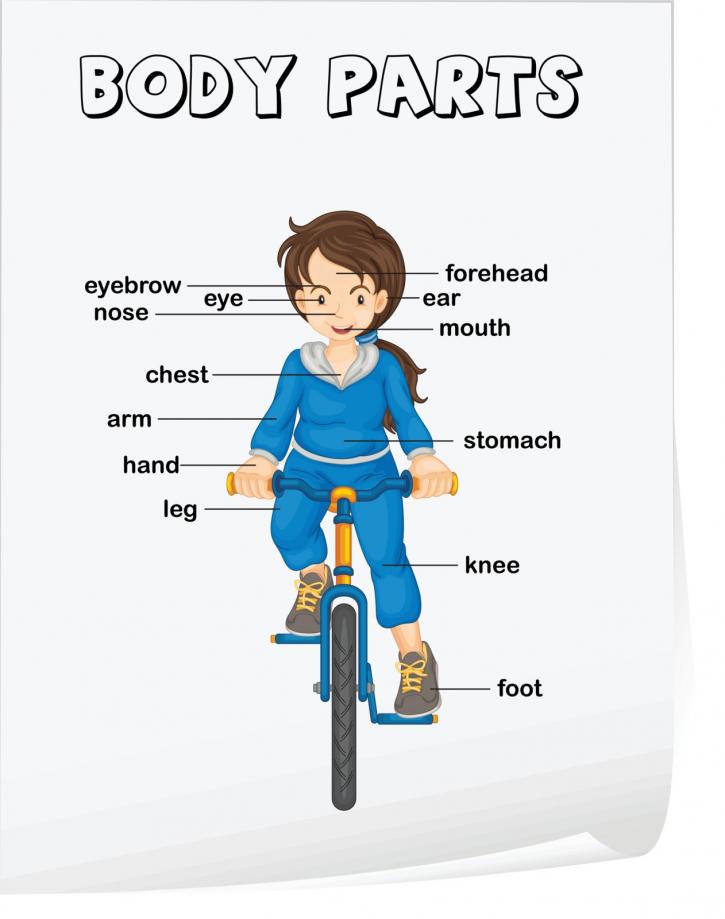
Knowing frequently-used words is essential and will help you understand, as does the context in which you're having the conversation. And yes, knowing at least some of the 13 body parts, shown on this drawing above, in your target language will be useful. You'll certainly come across many of them in your studies.
But if you're learning a new language, you've probably realized that “communicating,” i.e. participating in a conversation, is not that easy, even if you've practiced tons of words: You have to be able to LISTEN and COMPREHEND and then also to SPEAK.
LISTENING COMPREHENSION
Listening comprehension is learned with what the well-known linguist Stephen Krashen calls listening to“comprehensible input.” A lot of it.
Real conversations are often unpredictable in content. So listening to various kinds of topics you're interested in will help prepare you. Withtime, you'll start noticing and assimilating certain language patterns, even if there's a great variety in vocabulary.
Also, when you first start listening it will appear that the sound stream goes too fast. It's an experience most language learners share. I still remember arriving in Italy some years ago. Even after having completed three Levels of the Pimsleur Italian audio program (90 lessons), I could not distinguish individual words while watching Italian TV.
After several weeks, the rapid-fire Italian seemed to slow down for me. I was more and more able to distinguish individual words, then sentences, and finally to understand the context and meaning.
If you're a novice practicing listening comprehension, start out slow, with individual words, phrases, then sentences. Short audio stories are a good next step. Make sure you know the meaning of what's being said.
For the more popular languages, there now are free podcasts and YouTube videos available. Many of the free or fee-based online language programs have podcasts or videos as well (including GamesforLanguage).
LEARNING WORD ORDER and GRAMMAR FORMS
When you learn a foreign language, you're learning how to combine words in a new way that is meaningful in your new language. In other words, you're learning a second (or third, etc.) word-order system.
You're also learning grammar forms that don't exist in your own language. In English, you don't have noun gender, for example. French, Spanish, and Italian have two: masculine and feminine, German has three: masculine, feminine, and neuter.
Or, the language you're learning has a different way of forming a question. A case in point: French has three ways to ask a question, and none of them follow the pattern of English. That means you're learning two different grammar systems that your brain will alternate between.
Dealing with two (or more) grammar systems makes a teenager or adult different from young children learning their first language. Between the ages of two and three or so, toddlers go from one- or two-word “sentences” to quite sophisticated ways of asking questions, saying what they want, telling you what they saw, repeating what they heard, teasing you, etc.
Despite some hits and misses, children seem to catch on quickly which words go into what order, and what grammar forms to use. Most amazingly, often what they say are new combinations, and not just sentences they've heard and are repeating. Children are able to do that because of their brain's powerful “learning mechanisms,” which allow them to assimilate patterns of usage though listening.
Pattern learning also holds for adults learning other languages. The more we're exposed to the patterns of usage of a language, the better we'll acquire them. However, compared to children learning their native language(s), adults' exposure to a new language - in a class, online, reading, or listening - is typically more limited. (Unless, you're “immersed” in the language in the country or community where it is spoken, etc.)
For becoming conversationally fluent, you need to develop two skills: understand what's being said and create speech that is meaningful and relevant.
READING
You don't directly need reading for becoming conversationally fluent. Children learn to speak in sentences years before they learn how to write them.
And in many countries there are still adults who can't read or write. In fact, I was shocked to read the following, when googling for “U.S. illiteracy rate”: “According to the National Center for Educational Statistics (NCES), 21 percent of adults in the United States (about 43 million) fall into the illiterate/functionally illiterate category.” [April 29, 2020] Other sites give much of the same statistics.
Adults don't NEED reading to become conversationally fluent. But for most, reading is still the most practical way to accelerate their learning in class, with exercises and apps, or with online programs.
Furthermore, as soon as you're able to read news articles, blog posts, even books in your new language, you have several potential benefits: • For one, reading is another way to assimilate the word-order and grammar patterns of a language. • Also, reading will expand your vocabulary and teach you how to guess meaning from context. • Finally, by reading you acquire ideas and facts about topics you want to talk about. Everyday conversations don't stop at questions such as “Where are you from?” “What work do you do?” They are also very much about ideas, events, and if you're brave, about history and politics.
SPEAKING
I very much like the motto of the late Dartmouth Professor John Rassias, a effective promoter of the immersion teaching method: “Don't learn to speak a language, speak to learn it.” Speaking fluently can only be learned by actually speaking.
You won't learn to speak automatically just by doing lots of reading or listening. Yes, both will expose you to the characteristic word-order and grammar patterns of the language. Listening will train your ear to the language's sounds, which is essential when the sounds are quite different from your native language.
But, speaking a foreign language involves transforming your thoughts into specific sounds by training your vocal chords and moving your mouth in a certain way. It also means creating a stream of sounds that has the particular rhythm, pitch, and intonation, etc. of the language.
All of that has to be practiced aloud, typically by imitating native speakers. A teacher or tutor will be able to correct your pronunciation and point out different ways the tongue or mouth can produce the desired sounds.
Apps or online programs that have recording features are quite effective for improving your pronunciation. By playing back your own recordings and hearing how you sound next to the native speaker, you can work on making changes.
As a novice, start out slowly. Listen and repeat as often as you can. Don't be discouraged when you hear yourself for the first time. Memorize conversations, even act them out, mimic the native speakers – have fun sounding like a native!
FROM REPETITION to LANGUAGE FLUENCY
It's very hard to have a genuine conversation just with sentences that you've memorized. So how does one progress from a "low intermediate" level - where you canask and answer basic questions -to speaking freely about everyday topics? Certainly, repeating words and sentences aloud, and learning them by rote are essential techniques for a beginning learner.
But then, conversations with friends or exchange-partners who are native speakers, or a tutor who only uses the target language are the best way to improve your language fluency and conversational skills in your target language.
Talking with someone is a complicated back and forth that creates a context for words and sentences. With talking come all kinds of “filler words and sounds” that are normal for a casual conversation.
Participating often in such open-ended conversations will expose you again and again to the typical patterns of the language you're learning and prompt you to use these patterns yourself. So yes, learning 90-95% of words commonly used is an excellent language learning goal. And if you learn them in context, rather than as words in a list, you'll be building conversational skills.
Even if you understand all the words, you still have to decided whether someone is asking for something or telling you what you should do. You have to figure out how to formulate a question, express a reasoned opinion, or how to comment to a fast-moving conversation of your friends or family.
Getting to that level of fluency takes more than just words, it also takes much listening and many conversations on a variety of topics. And it takes friends and conversation partners to practice with.
Bio: Ulrike Rettig is the co-founder of GamesforLanguage.com. She is a lifelong language learner, growing up in Austria, the Netherlands, and Canada. You can follow her on Facebook, Twitter and Instagram, and leave any comments with contact or below.
Postscript: A comment by a Reddit reader (where the Post had been listed) prompted us to add a section "Learning Vocabulary" in a revised version which was published by Lingohut as Learning Words and More for Language Fluency.

 It's been about a year now that daily life has been upended by the pandemic. Like most people, we at GamesforLanguage have gone through various kinds of moods and emotions. As you can expect, the pandemic blues have included periods of heightened boredom and lowered motivation for language learning.
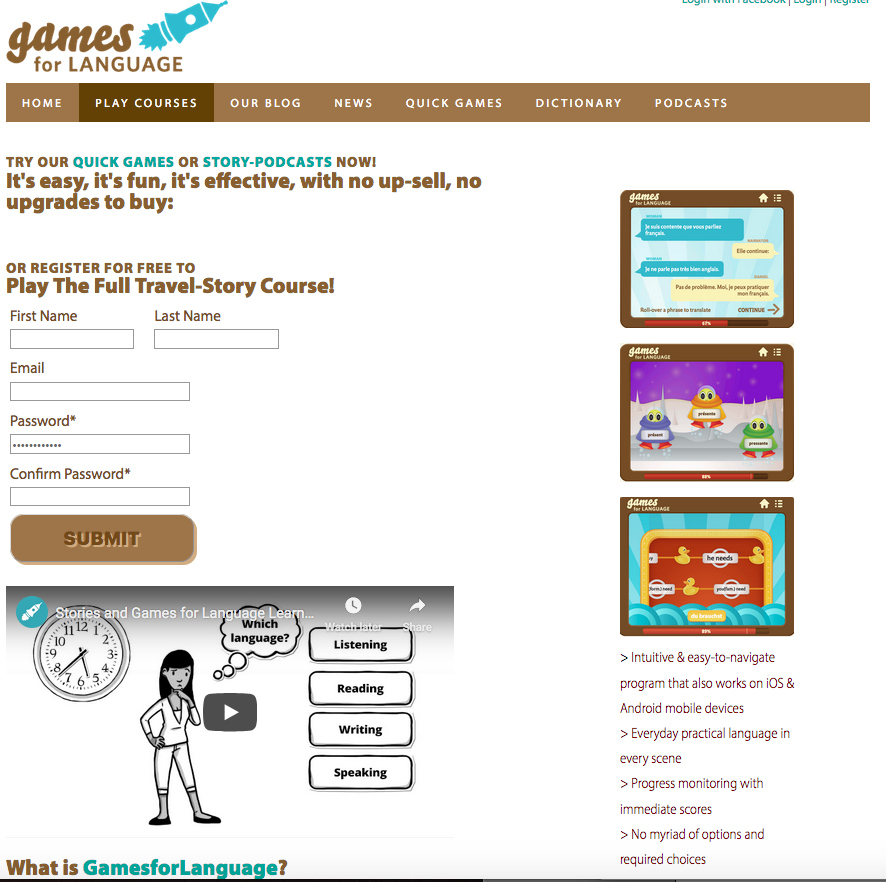
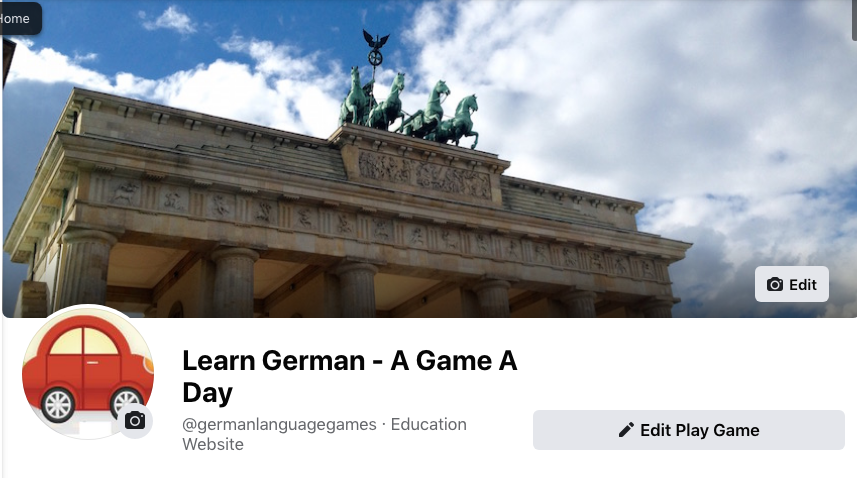

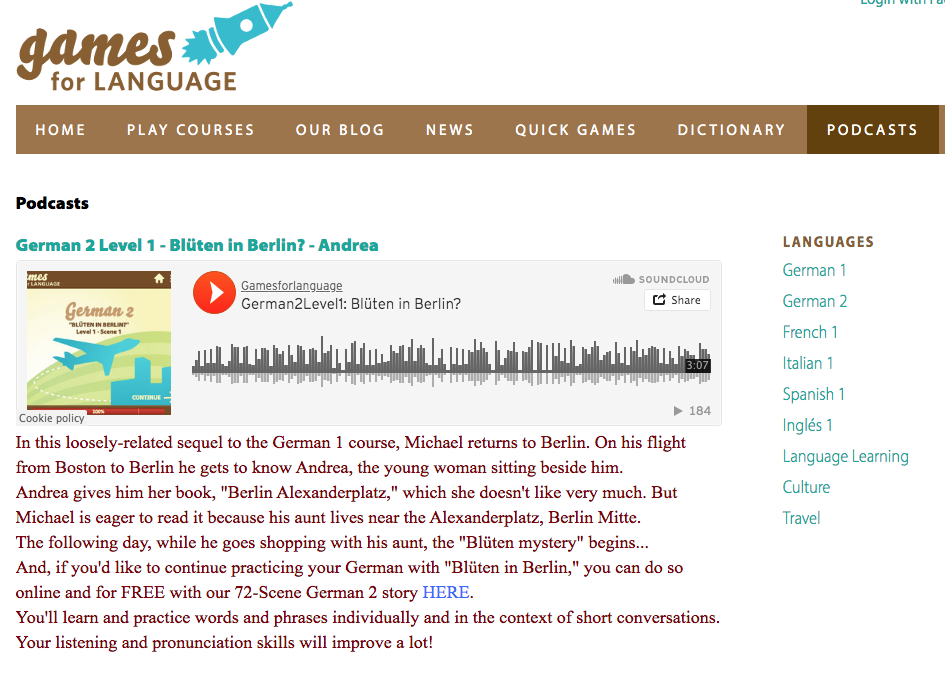
 In the fall, we'll be spending two weeks in Bordeaux, France. So, before we get there, I'm super eager to take my French up a notch or two.

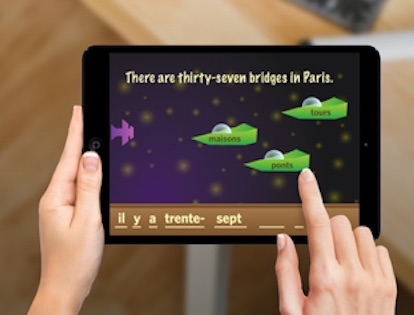








 We may not feel that we are "wired for grammar" (as Noam Chomsky once suggested), but we are certainly wired for recognizing and internalizing patterns.
  When you're happily into your new target language, when you continue to feel motivated and love the progress you're making, that's the time to tackle more grammar. But don't focus on rules. Focus on typical patterns. Below are two examples.








 the Ben Zimmer's discussion of "chunking" in language learning: "We assume language is assembled in the brain primarily in word-word-word form, but instead it may come in more pre-assembled phrases than we have previously realized."