
Language Learning Without Traveling?
 (Updated 4/15/2017)
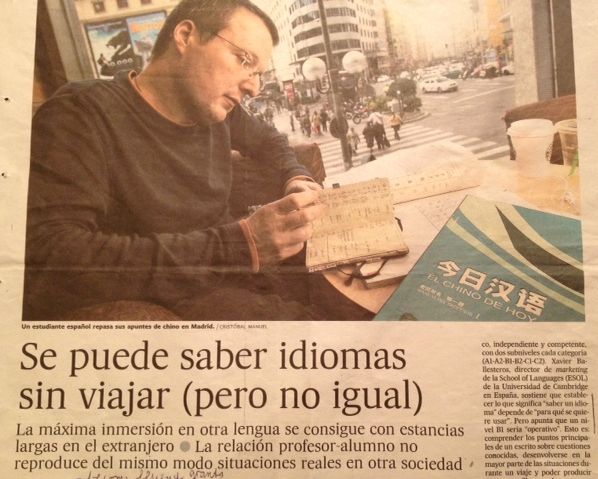
A couple of days ago the national Spanish newspaper El País ran the following article:"Se puede saber idiomas sin viajar (pero no igual)" [One can know languages without traveling (but not equally well)].
The article then continues: “Can one become fluent in a language without traveling? Yes, according to the Minister of Education, José Ignacio Wert. No not entirely, according to the majority of experts.”
Now that we have stayed in Barcelona for a couple of weeks – we rented an apartment for a month in the Gracia neighborhood of town - it makes total sense that being in Spain adds a huge level of reality and relevance to the Spanish words, phrases, and sentences that we learned with our Spanish 1 course to prepare for the trip.
Traveling is great - Practicing is essential
Yes, Barcelona is totally bilingual – we also hear and see a lot of Catalan (which we actually can read pretty well, see an earlier blog post). Still, Spanish is all around us.
We've been immersed in Spanish right from the moment of arrival, when our taxi driver greeted us with a rush of Spanish, and then patiently engaged us in Spanish small talk about the weather, the traffic, FC Barcelona, etc.
It's great that we can use Spanish for everyday life. No problem doing our food shopping at the market or in one of the many little shops around; or, ordering meals in cafés or restaurants and paying for them. We can ask directions, ask for information, and for explanations.
We can even make small talk with people standing next to us in shops, or sitting at a table next to us in a café. (We often use the phrase: ”Gracias, pero quiero practicar mi español” - when somebody tries to be helpful in English...)
But for us this is just a start. What then are the next steps to getting out of the “eternal intermediate level,” as Alejandra Agudo, the writer of the article, aptly calls it?
The most important one is to continue to build on your language skills: Continue to acquire practical and relevant language and absorb its grammar in a meaningful way.
Real-Life language helps you to communicate
Beyond that, Alejandra Agudo points to two other recommendations that we subscribe to enthusiastically:
• Learn the language that is really spoken - “el lenguaje de la calle” (the language of the street).
Don't just learn textbook language which also may be a little outdated. A couple of examples for here in Spain: We hear the word “vale” spoken dozens of times a day. Literally, "vale" means "it's worth." But in Spain, it's the equivalent of OK, and everyone says it in any situation. Or, a shopkeeper or waiter will say “Dígame ...” to ask what we want. And, in general, much to our surprise, the casual form of address is used a lot here, even with us!
• Make the language you are learning part of your life.
Start keeping a journal in your new language, even if it's just a couple of sentences a day. Whatever self-talk you do, do it in Spanish, German, French, etc. Look up and learn the words of everything in your surroundings and of your daily activities: chair, table, door, I'm setting the table, I'm getting the newspaper, etc. and say them to yourself, aloud, if possible. In that way, learning a language successfully is almost a life-style choice.
Language learning is a process of building. You create a good base of knowledge and understanding, and then, thoughtfully, gradually, with many repetitions, you start adding to it. Traveling or not, your language skills will improve dramatically. (And, if by chance you'll be traveling to Barcelona our Spanish Travel Memories may interest you.)